



The Dollar Waits for Wall Street to Reopen
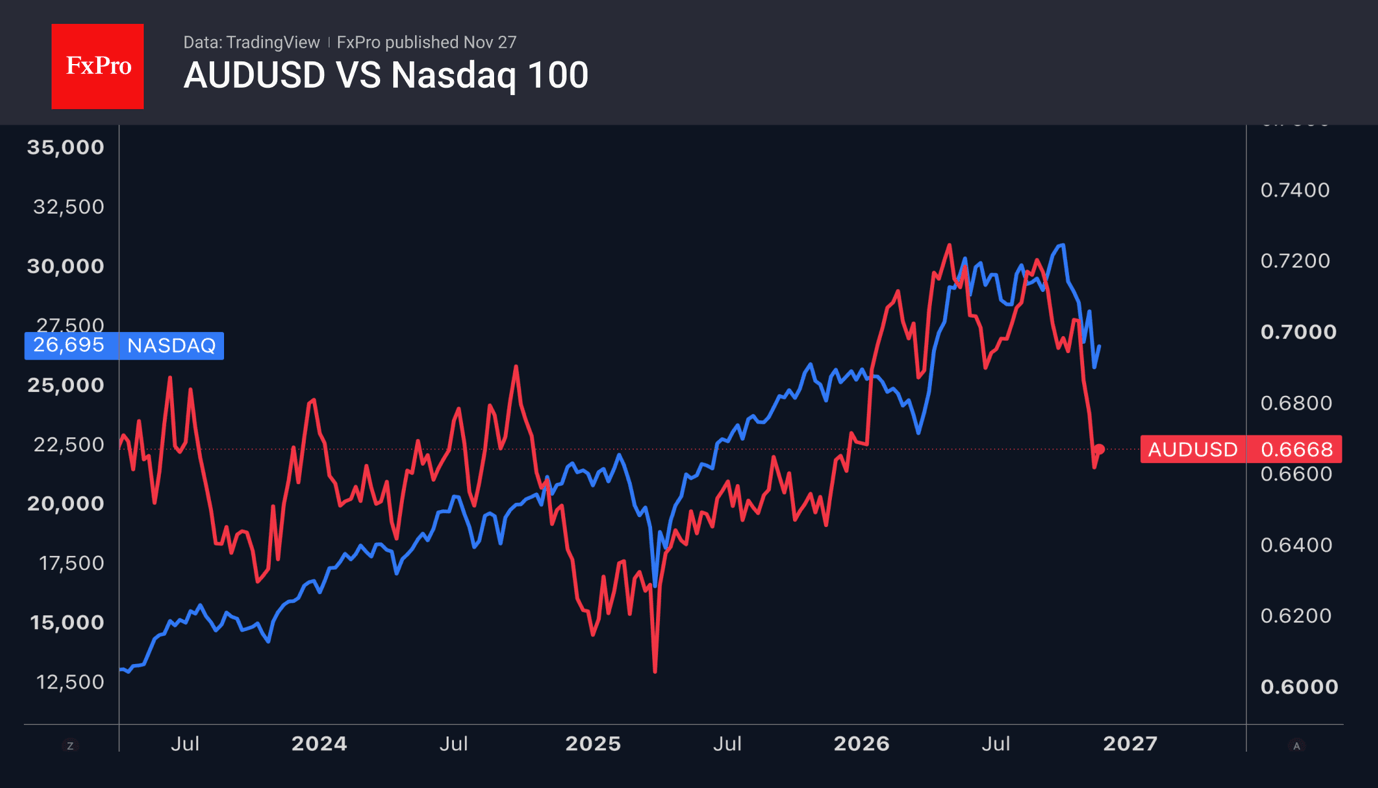
The US dollar has lost its main driver. US stock markets were closed for Thanksgiving, and equity index performance has determined the greenback’s fate in recent days. A post-holiday rally could support higher-yielding currencies such as the Australian and New Zealand dollars. Conversely, a further correction in the S&P 500 would be a reason to return to the yen and the Swiss franc. The impressive rise in US index futures may prove deceptive, so it is better to wait for regular trading in the US session.
Related guide: FX Seasonality: What Still Works For Forex Trading in 2026—and What Doesn’t
That said, interest in the greenback is driven by more than US equities and artificial intelligence. A strong economy, accelerating inflation, and the Fed’s determination to keep tightening monetary policy are providing tailwinds for the US dollar. It is on course for a third straight monthly gain, its longest winning streak since late 2024.
The Euro: A Hawkish ECB Account, French Politics and an “Owl” at the Helm
The euro will face difficulties due to French politics and doubts as to whether the ECB will be able to raise interest rates after December. In the account of the Governing Council’s October meeting, officials deemed a December rate hike necessary if inflation did not slow down. Consumer prices, however, have accelerated.
However, the ECB’s next moves are not so clear-cut. This is particularly true following the nomination of Pablo Hernández de Cos as the next President of the ECB. The Spaniard has previously described himself as an “owl”, preferring to make decisions based on data. He does not consider himself to be either a hawk or a dove.
Trade with China and a Rebound in Brent Weigh on EUR/USD
The widening of the EU’s trade deficit with China is putting pressure on EURUSD, and this has been a key factor behind the euro’s weakest performance against the yuan in two decades, between January and November. Meanwhile, Berlin believes the renminbi is still undervalued by approximately 30%.
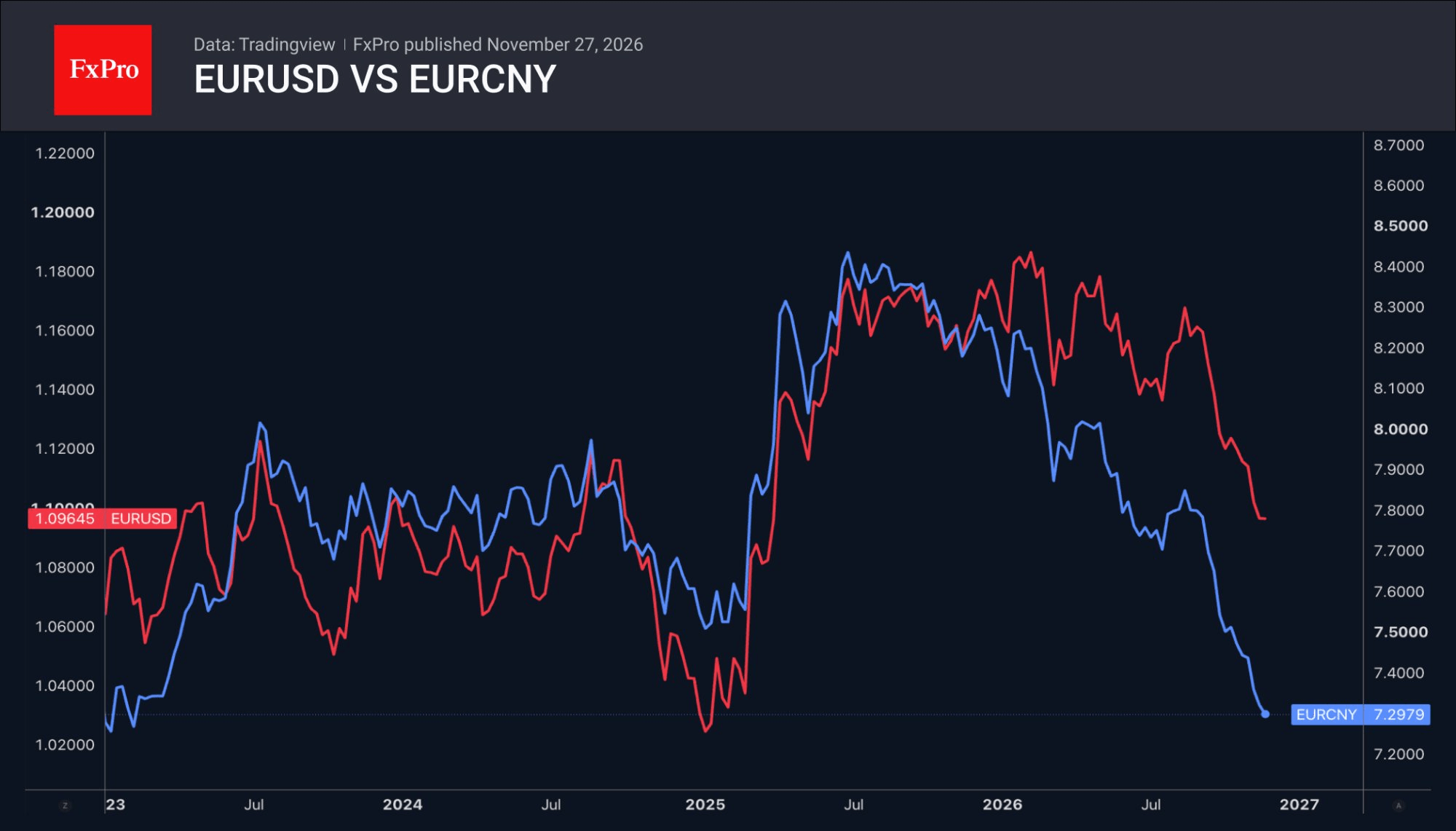
The sell-off in EURUSD is also being fuelled by Brent heading for its first weekly gain in a month. The oil market has been rattled by rising tensions in the Middle East. If an escalation of the conflict reduces exports from the region, the North Sea benchmark risks climbing further. That would increase the risk of high inflation becoming entrenched in the US and force the Fed to accelerate its tightening cycle.
EUR/USD Price Forecast
Every new EUR/USD analysis as it publishes, today's technical signal and key levels, live price — on one page.
See all EUR/USD forecastsCrypto Tries to Break Through Resistance at $2.11T
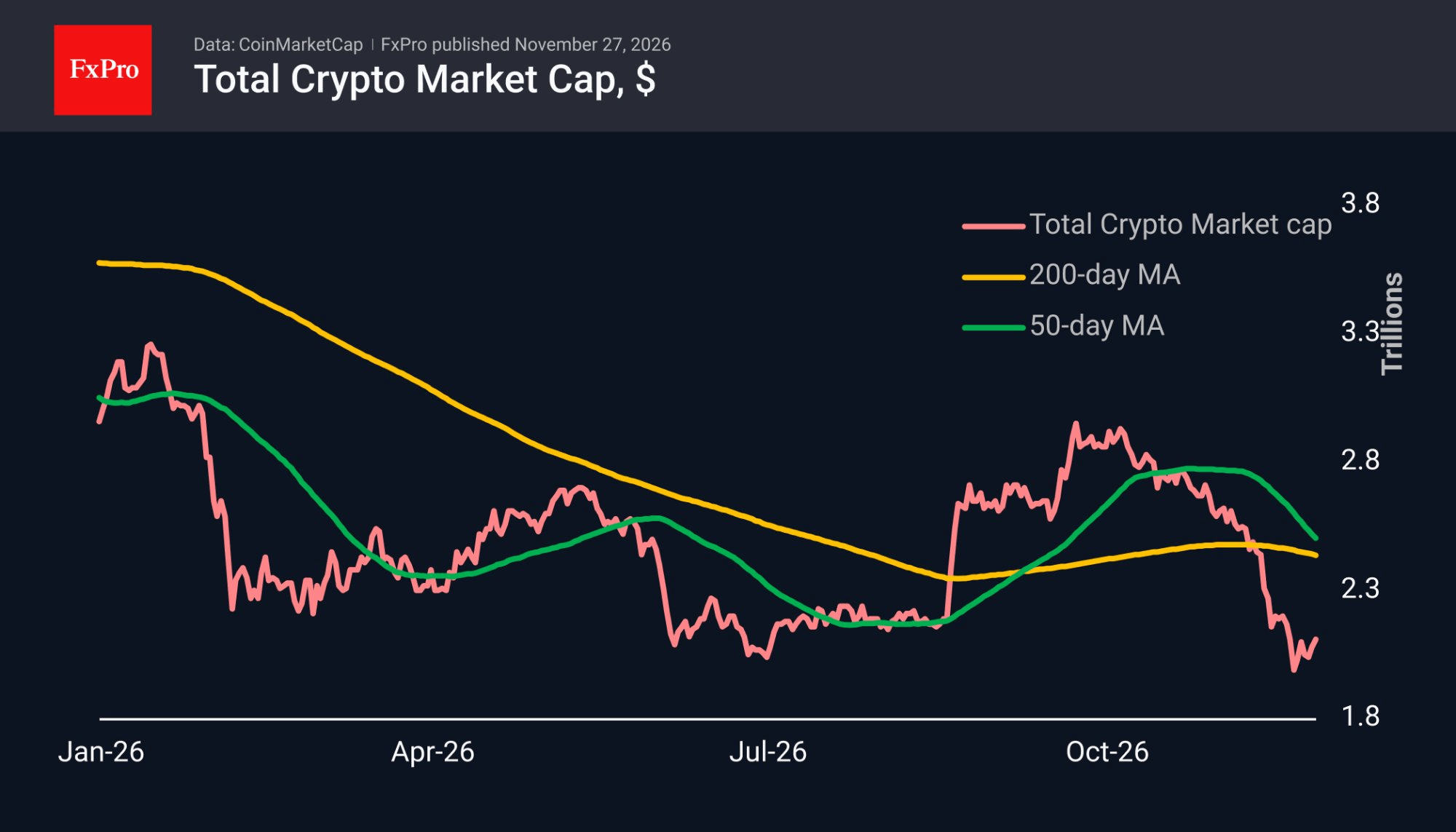
The crypto market capitalisation has recovered by a further 1.4% to $2.11T, approaching the upper boundary of the range seen over the last eight days, during which we have witnessed heightened volatility, with attempts to break down at the lows. The current period of consolidation, should it drag on, will face resistance at the former July–August support. Over the summer, however, the market repeatedly turned lower as it approached the February–April lows.
This sequence of lower local lows is not confirmed by lower local highs, which by early October had exceeded those of May, suggesting a break in the downtrend. However, the latest dip has made us more cautious, though we maintain a positive outlook on near-term prospects. Over the past 24 hours, the top performers were Hyperliquid (+6.8%), Chainlink (+4.4%) and Aptos (+3.7%). The three worst performers on our list of liquid instruments were Cosmos (-0.7%), Official Trump (-0.1%) and Tron (+0.4%).
Bitcoin at $61.6K: $64K Would Signal a Shift, $57K Would Revive the Bears
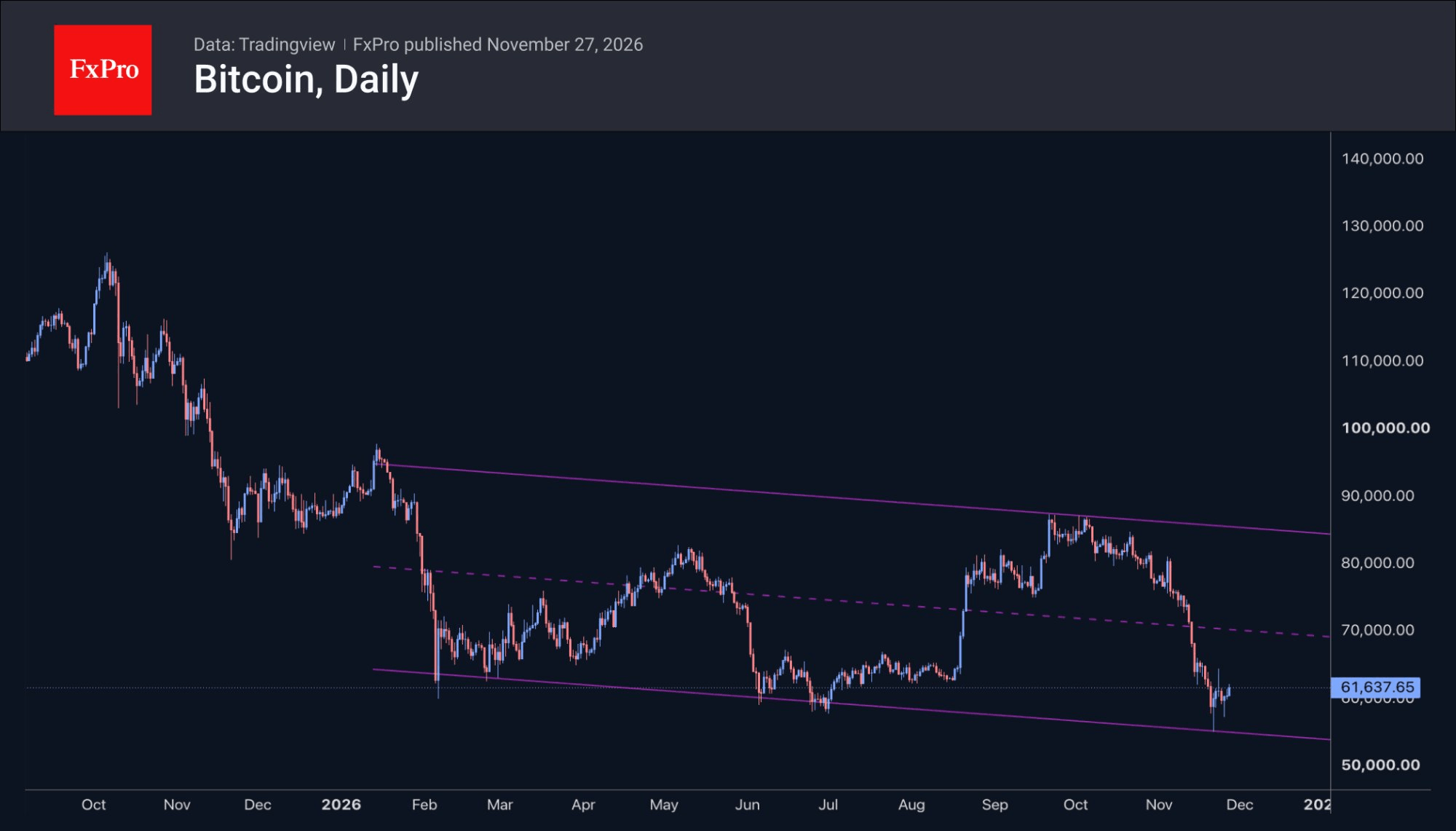
Bitcoin rose by 1.5% to $61.6K, returning to the upper boundary of its local trading range, excluding Monday’s spike following the Nasdaq-100. A move above $64K would be a serious indication of a shift in market sentiment. However, such positivity should be taken with a pinch of salt, as it has yet to be tested for liquidity when traders return next week. A drop to $57K would signal a return to the short-term bearish scenario.
What to Watch
Base case for forex: in our view, the strong US economy and a hawkish Fed keep tailwinds behind the dollar, and a return of EURUSD above 1.10 would require a continued correction in US equities. Risk: consolidation above 1.10 and then above 1.12 would signal a reversal to the upside, while a break below 1.0880 (the lowest since April 2025) would open the way to a further decline.
Base case for crypto: in our view, the market is consolidating near the upper boundary of its weekly range, but the positive momentum has yet to be tested for liquidity when traders return next week. A Bitcoin move above $64K would be a serious signal of a shift in sentiment. Risk: a drop to $57K would bring back the short-term bearish scenario.
Upcoming: euro area CPI and ISM on 1 December; NFP on 4 December; the Fed decision on 9 December. Check the economic calendar for more events.
Disclosure: FxPro Group Ltd is the holding company of FxPro UK Ltd, FxPro Financial Services Ltd and FxPro Global Markets Ltd.
This article is for information only and is not investment advice. Trading CFDs, forex, stocks and cryptocurrencies carries a high risk of losing money; past performance is no guide to future results.