

Impact of US Economic Data
Recent US economic data has shown mixed results, affecting the Gold price forecast. Initial Jobless Claims fell by 8,000 to 215,000 for the week ending May 18, beating expectations of 220,000 and the previous week’s reading of 223,000.
Additionally, the US S&P Global Manufacturing PMI rose to 50.9 in May from 50.0 in April, while the Services PMI climbed to 54.8 from 51.3, both surpassing market estimates. The Composite PMI jumped to 54.4 from 51.3, the highest level since April 2022.
Influence of Federal Reserve Remarks
Gold investors are closely monitoring statements from Federal Reserve officials for further cues. The Fed’s Waller is set to speak on Friday, and hawkish remarks from policymakers could weigh on the yellow metal.
Higher interest rates typically hurt gold prices by increasing the opportunity cost of holding non-yielding assets like gold.
Moreover, the upcoming US Durable Goods Order and Michigan Consumer Sentiment Index releases will also provide further direction for gold prices.
Geopolitical and Global Market Factors
China’s private sector imported 543 tonnes of gold in Q1 2024, and the People’s Bank of China added another 189 tonnes to its reserves during the same period.
Additionally, gold imports to India, the world’s second-largest gold consumer, might decline by about 20% in 2024 as high prices encourage retail customers to exchange old jewelry for new products.
Short-Term Forecast
Gold prices (XAU/USD) are likely to face resistance at $2,351.20, with support at $2,311.15. Higher interest rates and geopolitical tensions could influence short-term movements, suggesting a cautious bullish outlook.
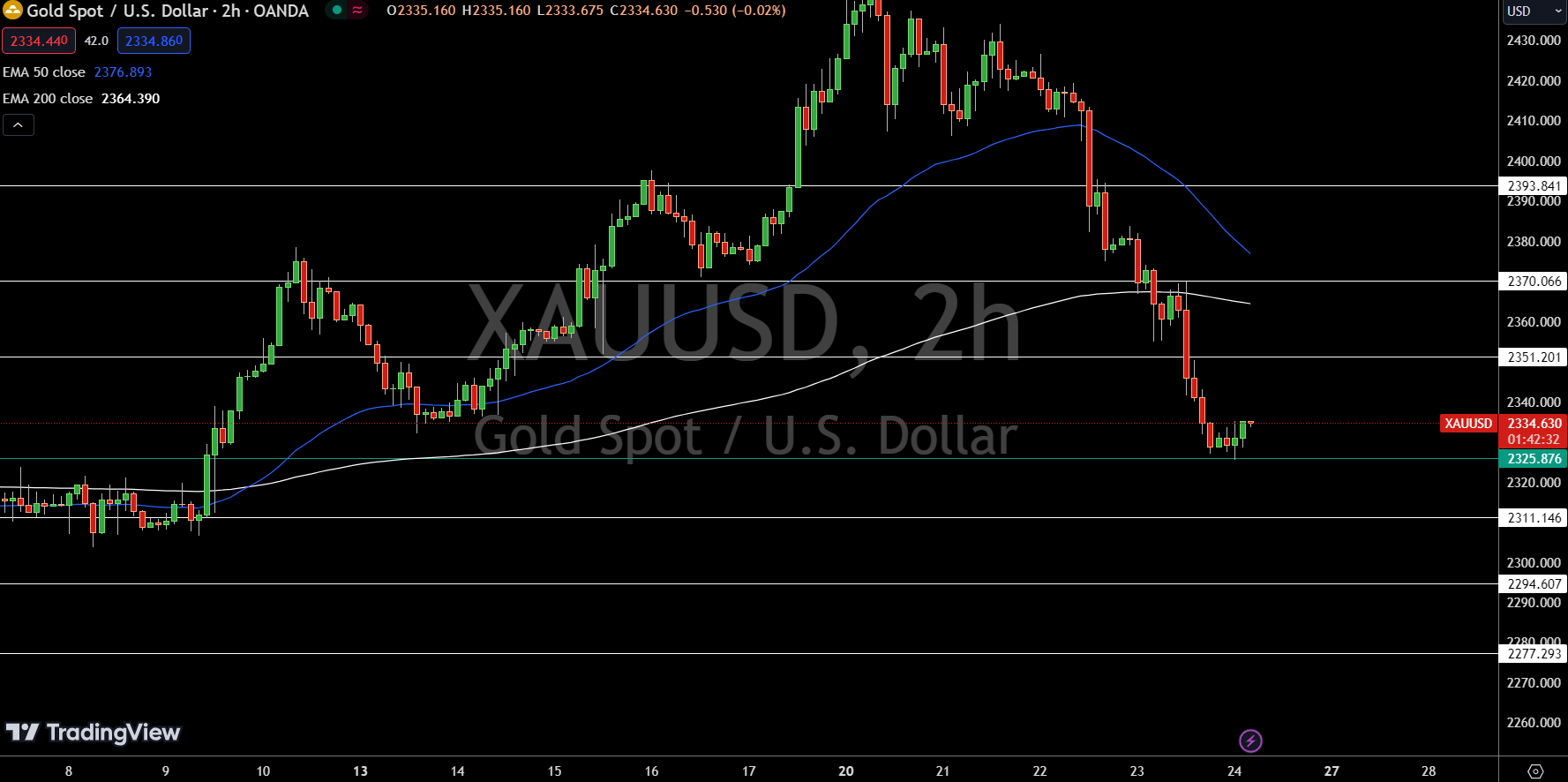
In conclusion, as long as gold remains above the pivot point of $2,325.88, the outlook remains bullish. However, a break below this level could trigger significant selling pressure.