


Silver is currently weak, and that weakness is easy to understand when the metal is treated as two overlapping markets, not necessarily just one. Investment capital has been reassessing the appeal of precious metals as U.S. yields continue to rise, while industrial users are changing how much silver they consume and where they put it.
Silver Institute’s Outlook
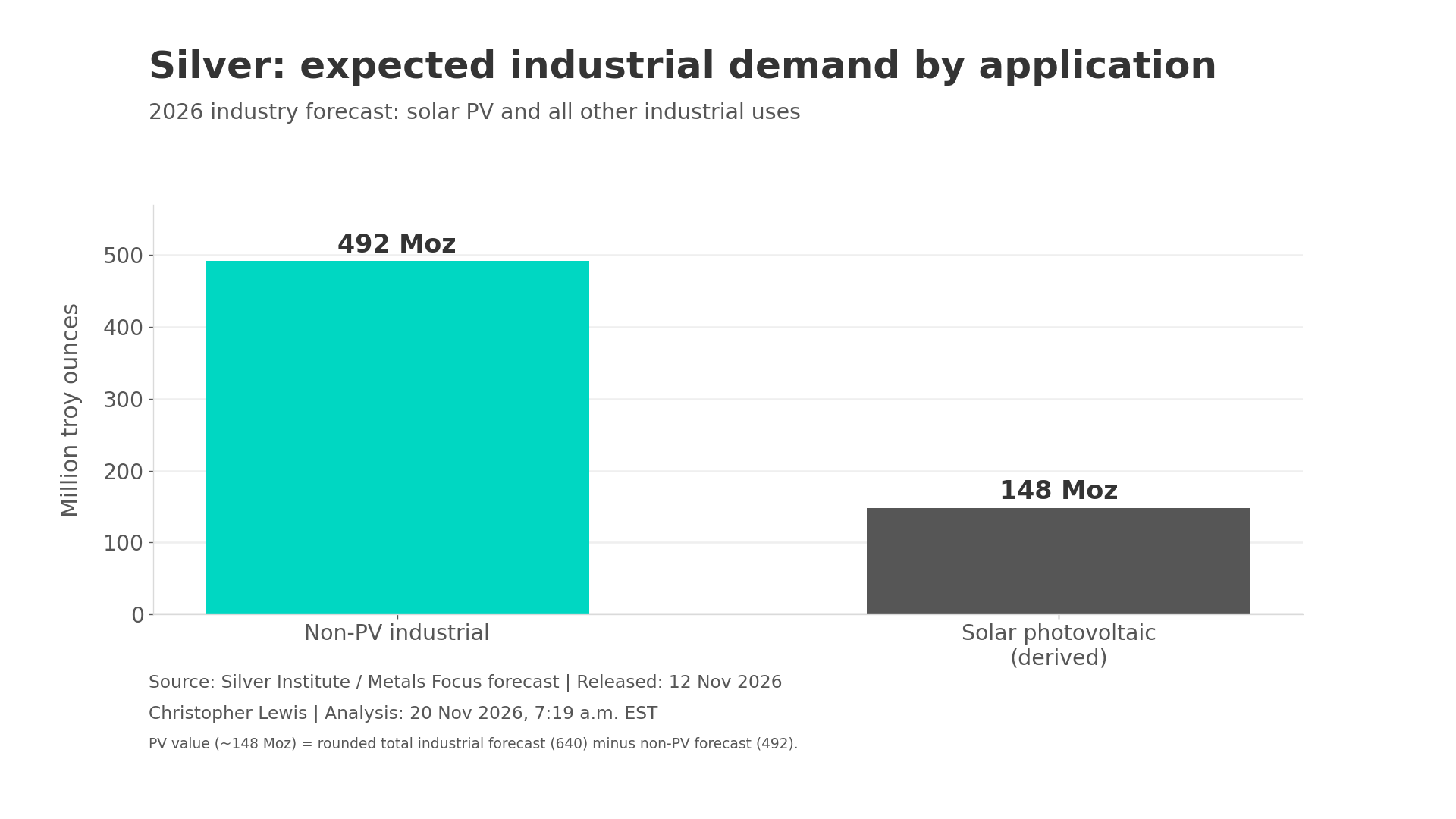
The most striking finding in the recent data is that demand outside solar panels and the like is still expected to grow even as the total industrial category contracts. The Silver Institute’s November 12 outlook, prepared with Metals Focus, projects 492 million ounces of non-photovoltaic industrial demand for 2026, a 4.5% annual increase. Overall industrial demand is forecast at about 640 million ounces, down 3% from last year.
Subtracting the non-PV component from the rounded total gives an implied photovoltaic component of approximately 148 million ounces. The accompanying bar chart explicitly labels that solar figure as a derivation from the industry’s rounded forecast. The difference is economically significant. Silver use in electrical contacts, vehicle and EV construction, charging infrastructure, and certain joining materials responds to investment across a broad group of industries. Photovoltaic demand is a narrow set of drivers.
Chinese Solar Not Performing
The Institute reports that solar installations have undershot expectations, especially in China, while higher silver prices have encouraged manufacturers to reduce the metal loading per cell or substitute other materials. Those are genuine mechanisms that can weaken silver consumption even when solar capacity continues expanding over a longer time horizon. It would therefore be inaccurate to treat stronger clean-energy investment as an automatic guarantee of stronger silver demand. Manufacturing technique matters just as much as the number of units produced.
Silver Price Forecast
Every new Silver analysis as it publishes, today's technical signal and key levels, live price — on one page.
See all Silver forecastsIf a solar manufacturer were to cut its use of silver per watt, more installed capacity does not necessarily translate into more demand for the metal. On the other hand, rising use in vehicles and electrical equipment can support non-PV consumption without fully offsetting the decline from solar applications.
Financial Positioning
Financial positioning explains why a deficit forecast doesn’t necessarily prevent a steep drop in price. The same November industry estimate forecasts total demand of 1.08 billion ounces, a 5% annual decline. It projects a sixth consecutive annual market deficit of 35 million ounces. That shortfall is material, but it’s just a forecast, and it’s not actual measured storage. Recycling is expected to rise 6%, mine production to remain broadly flat, and jewelry and silverware demand to fall 22% and 17%, respectively.
COMEX
The latest readily verified CFTC COMEX Silver Futures Only report available covers positions as of November 10. The standard 5,000-ounce contract has seen non-commercial traders holding 36,151 long contracts and 16,787 shorts, or a net long of 19,364 contracts. Compared with November 3, the net-long position had fallen 1,887 contracts. This is evidence of reduced speculative net exposure.
The Silver Institute also reported global silver exchange-traded product holdings of 1.25 billion ounces as of November 3, down 55 million ounces for the year despite a recovery from June. These holdings measure a different pool of investors from the futures-only CFTC series. Combining the two indiscriminately would double count some economic motivations and conceal the difference between longer-term physical exposure and leveraged trading positions.
Pressure Across the Metals Markets
On November 4, Reuters Precious Metals reporting described continued pressure across the metal complex amid a stronger dollar and higher-yield backdrop. Silver can move rather abruptly in comparison to gold because the demand base combines financial investment and cyclical manufacturing. When investors reduce risk at the same time as industrial forecasts weaken in one major application, the projected annual supply deficit can take a backseat.
Technical Analysis for Silver Looks Bleak
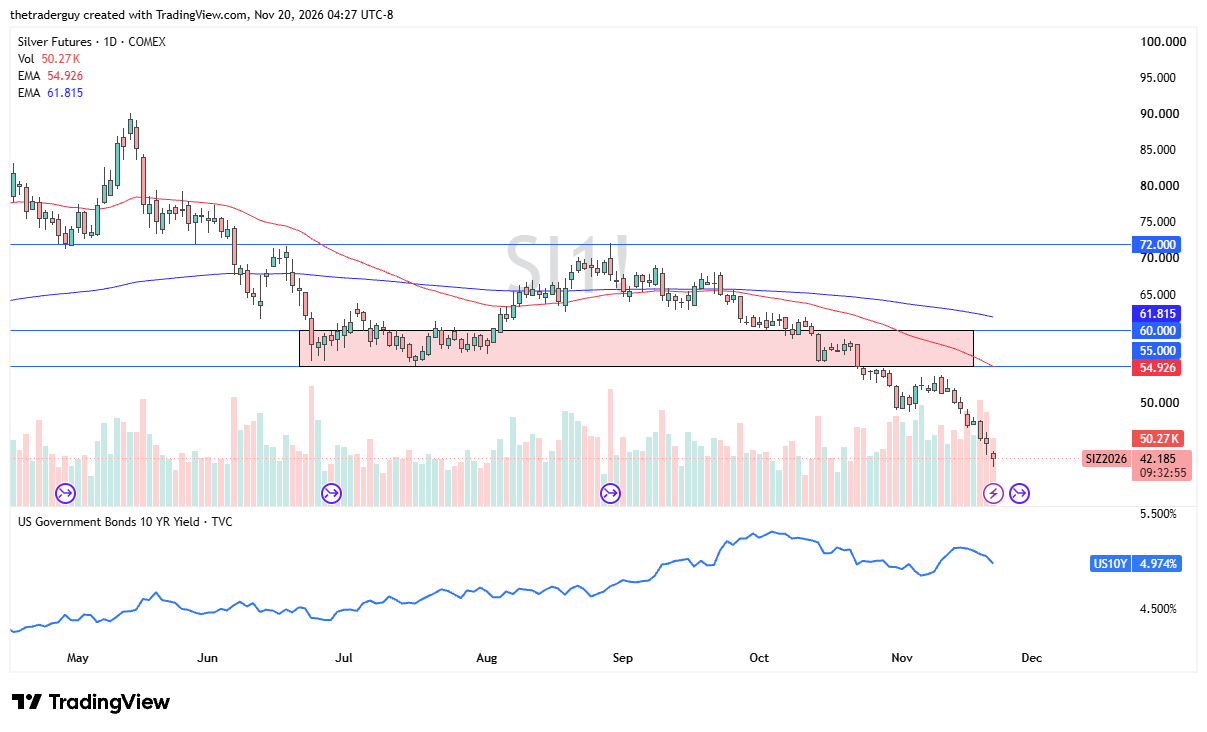
Going forward, looking at the charts, we can see that the silver market has collapsed, and quite frankly, the next figure of importance below is the $40 level. We have accelerated to the downside, and it’s very difficult to go in and start trying to pick up silver after this type of move.
Short-term rallies should continue to be selling opportunities at the first signs of exhaustion. I have no interest in buying this contract anytime soon, although I’m the first to admit that longer-term silver will be in demand again and it could be an investment. That being said, I’m not ready to make that trade quite yet.