


Silver kicks off Wednesday with two distinct pressures: a less supportive monetary backdrop and industrial data that shows improvement in some categories without demonstrating a complete and broad acceleration in demand. The metal’s investment and manufacturing roles can pull in different directions, and quite often do.
CME’s November 3 bulletin puts the December 2026 futures settlement at $49.75 per troy ounce at the close, down $1.13 for the session. This confirms Tuesday’s weakness in the contract but does not necessarily establish whether investment selling, industrial expectations, or another influence accounted for the move.
Real yields continue to present a measurable monetary headwind. The Treasury’s 5-year real yield rose to 2.35% on November 3 from 2.31% the day before, while the 10-year reading increased to 2.65% from 2.62%. Higher inflation-adjusted returns can make holding a non-yielding metal less attractive. That being said, it is not everything when it comes to trading silver.
JOLTS Report
The latest labor release provides additional context rather than a direct silver demand measure. September job openings were 7.5 million, according to the JOLTS report published November 3. The BLS characterized openings as showing little change, while quits increased to 3.4 million. These figures do not justify describing the labor market as suddenly collapsing, nor do they establish what factories are purchasing this week.
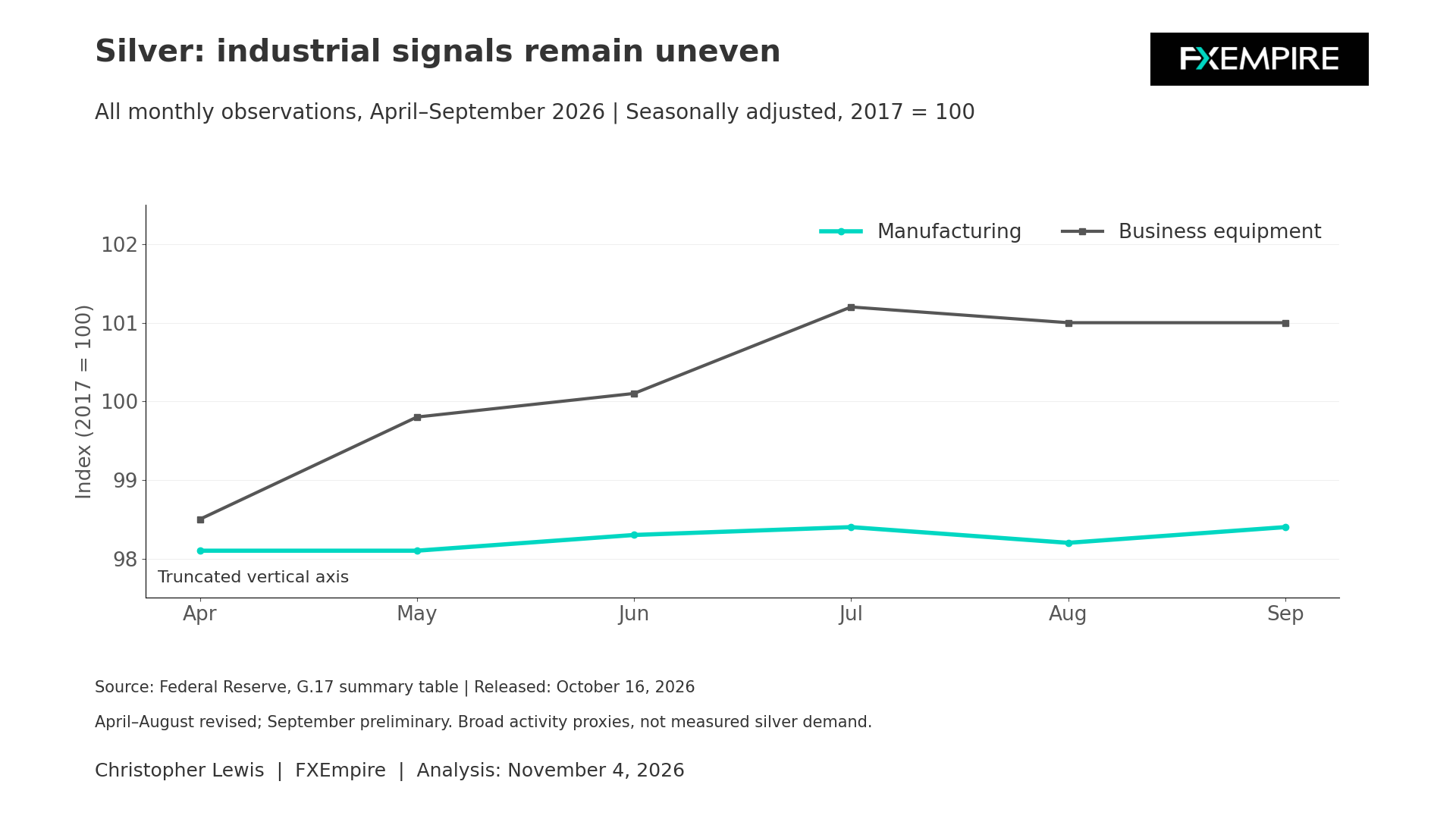
Industrial evidence is older but still useful when correctly assessed. The Federal Reserve’s October 16 release reported a September manufacturing output index of 98.4, compared with 98.2 in August, on a seasonally adjusted basis, with 2017 equal to 100. The business equipment index stood at 101.0 in September, unchanged from August and therefore above April’s 98.5 reading.
The chart below places those series side by side across all 6 months from April to September. I believe that capital equipment activity has shown more improvement over this interval than manufacturing overall. This is relevant background for an industrial metal, but neither index measures silver use directly.
This limitation matters, especially when discussing components such as electrical equipment and solar applications. In general, industrial expansion can support the demand narrative, yet the strength of that connection depends on the product mix, material substitution, and silver intensity. No verified new official series quantifying recent silver consumption in those applications and categories were available.
Silver Price Forecast
Every new Silver analysis as it publishes, today's technical signal and key levels, live price — on one page.
See all Silver forecastsHousehold Spending
Household spending also offers a restrained signal. The BEA’s September report, released October 29, showed real personal consumption expenditures increasing by less than 0.1%, while real disposable personal income declined 0.3%. This is evidence about inflation-adjusted U.S. consumption and income, not global silver demand. However, it does argue for examining the composition of growth rather than assuming normal nominal spending gains translate into stronger goods volumes.
Fed Policy
The Federal Reserve’s October 28 decision retained a target range of 3.75% to 4%. For silver, the analytical question is going to be whether forthcoming evidence allows financial conditions to ease without a substantial deterioration in economic activity. A combination of lower real yields and resilient production would offer a more coherent and constructive backdrop, rather than lower yields caused by pronounced industrial slowdowns.
Thursday’s preliminary productivity and cost release and Friday’s October payroll report, both scheduled for 8:30 a.m. Eastern, provide the next verified U.S. calendar announcements. Stronger productivity with contained labor costs could improve the inflation-growth tradeoff. Persistent cost pressure could complicate the monetary outlook, while weaker employment could raise questions about future consumer and business demand.
Because of this, we will have to watch both sides of the market for silver. A retreat in real yields does improve the investment backdrop. Sustained industrial support needs evidence beyond just a single manufacturing release. Conversely, higher yields together with weakening activity would leave fewer fundamental offsets.
Strong Technicals for the Session
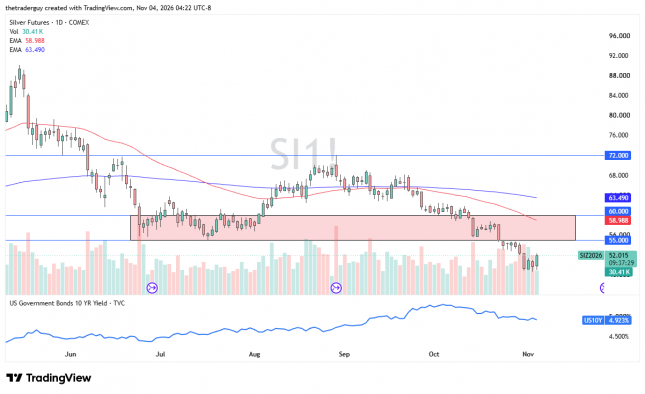
Silver has turned around and, in the short term, looks like it is trying to find its way back toward the $55 level. That being said, it is not until we clear the $55 level that I am completely convinced of rallies. The first signs of exhaustion will, more likely than not, attract selling pressure.