


Monday sees the U.S. dollar strengthening as investors adjust to the possibility that the Federal Reserve may need to raise interest rates even further to contain inflation. Meanwhile, global equity markets struggle while Japanese economic data has disappointed.
With oil prices declining as supply conditions improve, the U.S. dollar advanced on the U.S. Dollar Index to approximately 103.5 during Asian trading, extending its winning streak to five sessions and reaching its highest level since April 2025. The rally followed stronger-than-expected U.S. inflation data and increasingly hawkish commentary from Federal Reserve officials.
Rate Hikes Coming?
Markets are now pricing in a 25-basis-point hike at the December Federal Reserve meeting, with the probability of a larger 50-basis-point move remaining below 10%. This represents an important shift in monetary policy expectations, as traders increasingly recognize that inflation could require additional tightening rather than an extended pause, which some had been banking on.
This has implications beyond foreign exchange markets. Higher interest rates typically increase the relative attractiveness of dollar-denominated assets while simultaneously raising financing costs for businesses and governments across the planet.
Treasury Yields Trying to Ease
Treasury yields eased a bit on Monday following a particularly difficult week for government bonds. The benchmark 10-year Treasury yield traded near 5.12% during the European session, declining approximately 3 basis points after rising 29 basis points in the previous week. Elevated yields continue to complicate the outlook for securities, particularly equities. Technology companies, whose valuations depend heavily on expectations for future earnings, are particularly vulnerable.
The Federal Reserve’s October meeting minutes, scheduled for this Wednesday, could provide additional insight into policymakers’ willingness to tighten monetary conditions further. Investors will also examine upcoming U.S. retail sales figures for evidence of whether higher borrowing costs are starting to affect consumer demand.
Brent Oil Price Forecast
Every new Brent Oil analysis as it publishes, today's technical signal and key levels, live price — on one page.
See all Brent Oil forecastsUS Economy to Absorb Rates?
The question at this point is whether the American economy can absorb higher interest rates without experiencing a significant slowdown. The U.S. economy has been fairly strong, but the Japanese economy has shown a bit of a contraction. Preliminary government figures showed that the economy contracted at an annualized rate of 0.1% during the third quarter, following growth of 1.7% in the previous quarter. Private consumption declined 0.3%, showing pressure on Japanese households from inflation and elevated energy costs.
BoJ Still Expected to Tighten
Despite the disappointing figures, markets continue anticipating additional tightening from the Bank of Japan. The Japanese yen remained under pressure against the U.S. dollar, with the U.S. dollar trading around ¥159.70 during Asian trading. This creates a problem for Japanese policymakers. Higher interest rates could support the yen and potentially ease imported inflation, but additional tightening also risks weakening an economy already struggling to maintain momentum.
The approaching ¥160 level is particularly important because of concerns about potential currency intervention by the Bank of Japan.
EU Is a Mixed Bag at the Moment
European economic figures provide a mixed picture. Eurostat reported that industrial production increased 0.2% across the euro area in September, following a 0.5% decline in August. However, production remained 1.5% below its September 2025 level. The broader European Union recorded a stronger monthly increase of 0.5%, although annual production still declined 0.8%. Germany’s industrial production improved 1.3% during September, suggesting some stabilization in Europe’s largest economy.
Canada a Bit Weaker
Canadian October inflation reports offered another indication of how energy prices are influencing monetary policy. Statistics Canada reported that consumer prices increased 3.1% annually, matching September’s reading but falling below expectations of 3.2%. Monthly inflation was 0.2%.
Energy Remains in Focus
Gasoline prices increased 30.9% compared with the previous year, helping push transportation inflation to just under 9%. However, inflation excluding energy moderated to 2%, compared with 2.1% previously. The Canadian dollar weakened following the release, reflecting the possibility that underlying inflation may not justify additional tightening.
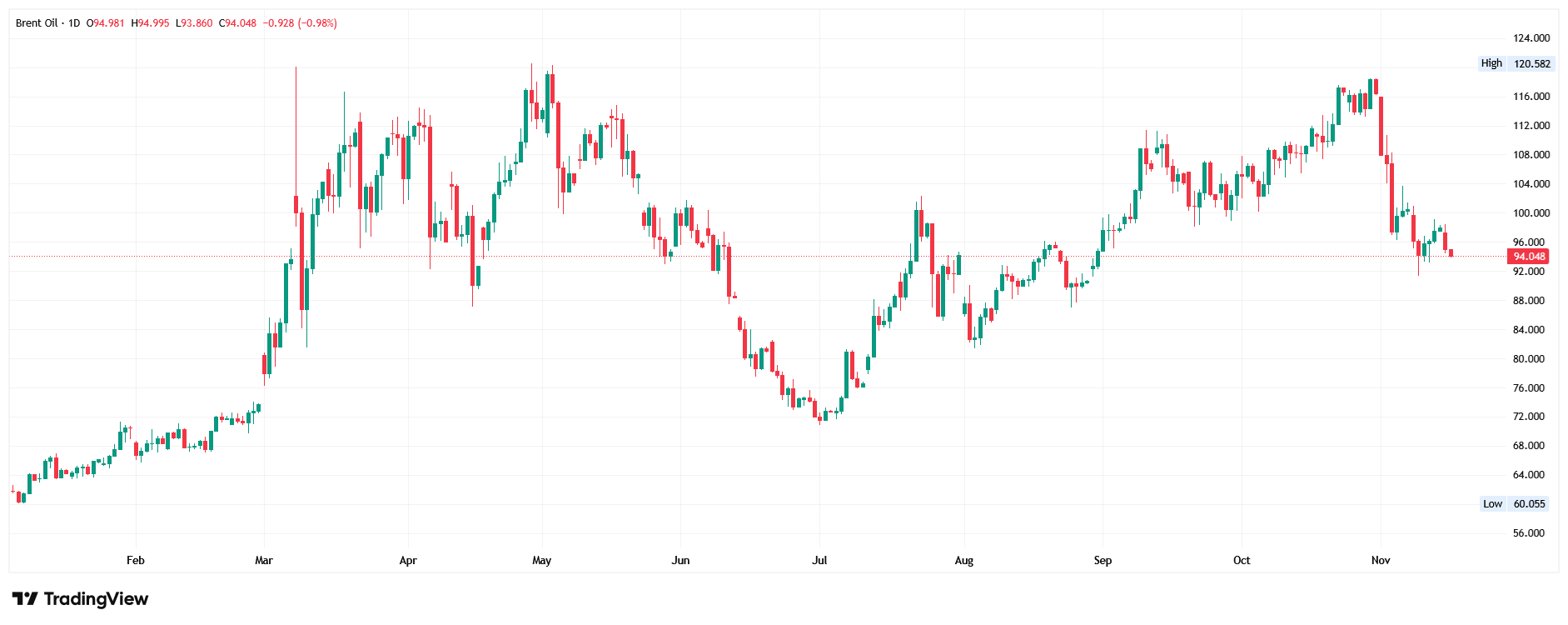
Crude oil prices declined on Monday as recovering Middle Eastern exports increased expectations of a potential supply surplus. Brent crude declined almost 2% during the trading session, while WTI also fell. The International Energy Agency expects global oil supply to exceed demand by approximately 1.7 million barrels per day during the fourth quarter.