Coinflare is a relatively new crypto exchange that rebranded from BITFLEX in 2024, after its original launch in 2022.
🪙 Supports 10+ cryptocurrencies and 90+ trading pairs across spot and futures markets.
💰 Trading fees are competitive, starting from 0.1% maker/taker on spot markets and 0.02%/0.06% on futures.
🔒 Security remains its weakest point, with no Proof of Reserves or insurance coverage, placing it behind top-tier competitors.
🎯 Features like an Earn program, API access, and gamified quests provide some added value for users exploring newer platforms.
In my opinion, Coinflare is best suited for curious traders and beginners who want to test a fresh exchange and benefit from its reward-based ecosystem. However, the lack of advanced security measures and low liquidity make it less appealing for high-volume or professional traders. As the exchange is still evolving, I expect to see significant improvements in features and transparency over time.
| Pros | Cons |
|
|
| Headquarters | Seychelles |
| Foundation Year | 2022 |
| Regulations | N/A |
| KYC Required | Yes |
| Minimum Fiat Deposit | 55$ |
| Native Token | No |
| Fiat Currency Support | N/A |
| Taker/Maker | Basic 0.2% / 0.1% Discounted 0.1% / 0.1% |
| Deposit | Crypto, TPPP (Third-Party Payment Processors) |
| Withdrawal | Crypto |
| Customer Supported Channels | Chatbot, Email, Live Chat |
Coinflare is available in over 170 countries, giving it a wider global footprint than many mid-sized competitors.
However, the exchange restricts access in 25 countries and regions due to local regulations and sanctions. These include the United States, Hong Kong, Singapore, Iran, North Korea, and several others across Africa and the Middle East.
Coinflare offers a wide variety of bonuses and special programs to reward both new and existing users.
Based on my testing, registering and completing basic setup unlocks access to Coinflare’s Rewards Hub, where new users earn Flare Points through activities like check-ins, deposits, and trading. While there’s no sign-up bonus, completing “quests” and challenges inside the Hub lets you earn points for vouchers, fee discounts, and prizes.
New users can take advantage of the Coinflare referral program by sharing their invite code. Referees and referrers both have the opportunity to earn Flare Points and cashback bonuses based on trading activity.
Additionally, Coinflare has an active campaign system, with frequent limited-time events. Coinflare’s reward system is one of the most gamified and generous among newer exchanges.
Coinflare is a crypto exchange that rebranded from BITFLEX in 2024. It originally launched in 2022. The team behind Coinflare is made up of experienced professionals.
Coinflare offers only basic security protections. While the platform has not experienced any known breaches since its launch in 2022, it lacks transparency and key industry-standard measures.
🔒 Supports 2FA and mobile-only multi-biometric login (fingerprint/face ID).
🧾 Mandatory KYC with fast verification, but not suitable for privacy-seeking users.
🧊 Relies on a combination of hot and cold wallets but lacks public details on custody structure.
| Coinflare Security Overview | Details |
| Proof of Reserves (PoR) | No Coverage |
| Insurance | Coinflare maintains an internal insurance fund sourced from user fees to cover losses during bankruptcies. If the fund cannot cover a loss, the exchange employs an Auto-Deleveraging (ADL) mechanism to stabilize the market |
| KYC Verification | Mandatory for all users |
| Security Audits | None |
| Account Security | 2FA + Multi-biometric authentication |
As I confirmed through Coinflare’s support team, the exchange does not offer Proof of Reserves (PoR), and there’s no public documentation or clear policy affirming reserve holdings.
The platform does not provide external insurance for deposits. There is also no indication of an internal insurance fund or indemnification mechanism.
The exchange supports two-factor authentication (2FA) and suggests best practices such as bookmarking the site to avoid phishing and securing passwords, although details on biometric or advanced security features remain unspecified.
I used their 2FA during my testing. The MBA feature is only available for the mobile app.
Coinflare has an online presence on X, Telegram, and LinkedIn, but transparency into its operational structure is limited. The exchange provides limited public information about licensing or regulatory compliance. Additionally, the exchange lacks verified ratings from security platforms.
Coinflare requires a mandatory Know Your Customer (KYC) process for all users.
The process is straightforward: I uploaded a government-issued ID and completed a liveness check using a webcam or mobile device. Verification was instant, my fastest KYC on any exchange, taking less than a minute after completing the process.
| KYC Verification | Limits | Data/Documents Needed |
| Verified Users | 50,000 USDT daily / 1.5M USDT monthly | Government ID + liveness check |
While Coinflare includes basic protections like 2FA and anti-phishing advice, it lacks key transparency features such as Proof of Reserves, insurance, and third-party audits. This may concern users prioritizing security and transparency in their trading platforms.
Coinflare’s desktop interface is clean and TradingView-powered, but the overall trading experience is limited and lacks depth.
💻 Offers spot and perpetual trading with up to 100x leverage, basic order types (limit, GTC, IOC, FOK), TradingView charts, Earn products, and API access.
📱 Mobile app is available on Google Play and via TestFlight for iOS, but remains basic and less refined than leading platforms.
📉 Overall, Coinflare trails far behind top-tier exchanges like Binance or Bybit due to its narrow product offering and lack of innovation.
| Trading Options and Additional Features | Availability |
| Conditional Orders | Limit, GTC, IOC, FOK |
| Derivatives Trading | Yes (perpetual futures) up to 100x |
| Options Trading | No |
| Lending & Borrowing | No |
| Staking | Yes |
| Copy/Social Trading | Yes |
| TradingView.com Integration | Yes |
| Auto Trading (Bots) | No |
| API Access | Yes |
| Token Launchpad | No |
| NFT Marketplace | No |
For our trading test, we thoroughly evaluated Coinflare. Our process included signing up, completing the Know Your Customer (KYC) verification, logging in, depositing funds, and making withdrawals. We also tested the trading functionalities by exploring different trading pairs and conversions, and assessed the associated fees for transfers and withdrawals. This comprehensive test allows us to provide an informed and reliable review of the exchange’s usability, features, and actual costs. Here’s our detailed analysis:
I registered with Coinflare using my email, country, and ID verification.
The KYC process required a passport or national ID plus a liveness check, which was completed quickly.
I deposited 190 TRX from Binance, paying a 1 TRX network fee. My funds arrived in less than 5 minutes without additional fees from Coinflare.
Trading back with a limit order also worked smoothly, though I had to refresh the page to see updated balances.
For derivatives, I opened a short position on TRX/USDT-P with 1x leverage (up to 100x is available). Execution was fast, though the interface felt slightly clunky compared to Bybit or Binance.
The fee was 1.1 TRX, slightly higher than Binance, but negligible. My funds arrived within 5 minutes.
Overall, Coinflare’s interface was simple. As a new user, I easily found buttons and started trading. The main drawback was needing to refresh the page to see updated futures balances.
The desktop platform is functional and user-friendly, with TradingView charting, order books, and recent trades.
Coinflare’s spot trading interface is split into two modes: Flash and Pro. The Flash version is beginner-friendly, featuring a simple chart and basic order placement tools.
The Pro version includes more advanced features like TradingView integration, drawing tools, order book, trading indicators, and a depth chart, making it more suitable for experienced users.
However, a key limitation is the very small selection of tokens: only 10 cryptocurrencies are available for spot trading. By contrast, top-tier platforms like MEXC or Binance offer 300+ trading pairs.
Coinflare’s derivatives platform also offers Flash and Pro modes, similar to its spot trading interface. However, both suffer from a limited token selection, with only 81 contracts available.
The exchange offers up to 100x leverage, which is above the industry average, but still lower than platforms like BYDFi that offer higher leverage options.
Coinflare’s Earn feature works like a fixed-term savings account, offering around 5% APR for 90-day lockups. While the rate is decent, the offering is limited and rarely available. During testing, all Earn products were marked as expired, making the feature unreliable compared to DeFi options or competitor exchanges.
Coinflare’s API supports both REST and WebSocket connections, allowing users to trade spot and futures and track balances with bots or external tools. However, strict rate limits may hinder high-frequency or advanced trading strategies. In my experience, the API is fine for basic use but not ideal for pro-level automation.
The Coinflare mobile app is available on Android and iOS and offers a streamlined experience similar to the desktop version. While it doesn’t include separate “Flash” or “Pro” interfaces, all core features (spot, derivatives, convert, wallet, and Earn) are accessible.
Coinflare has highly competitive trading fees, especially for active traders in both spot and derivatives markets.
💰Spot Trading: 0.10%/0.10% maker/taker fee
💰Futures Trading: 0.022%/0.060% maker/taker fee
Our review examines spot fee structures across three tiers based on trading volume, highlighting key savings via native tokens and discounts. The first tier usually covers casual traders trading up to $10,000 monthly, while higher tiers involve more advanced traders. We categorize users by trading style and expenditure, comparing fees with industry standards to assess affordability.
| Pricing tier | Maker/Taker Fee | Maker/Taker (Discounted) | Industry Average |
| Up to $10K | 0.10%/0.10% | 0.10%/0.10% | 0.41% / 0.51% |
| Up to $100K | 0.10%/0.10% | 0.10%/0.10% | 0.33% / 0.37% |
| Up to $500K | 0.10%/0.10% | 0.10%/0.10% | 0.25% / 0.29% |
Coinflare uses a VIP-tiered fee structure for spot trading based on a user’s 30-day trading volume
Coinflare’s base spot trading fees are much lower than the industry average, even at VIP0. The platform also offers regular promotions. When I signed up, I received a free spot with waived trading fees for a period.
For derivatives, Coinflare offers even more fee discounts:
| VIP Level | 30D Trading Volume (USDT) | Maker Fee | Taker Fee |
| VIP0 | ≥ 0 | 0.0220% | 0.0600% |
| VIP1 | ≥ 1,625,000 | 0.0180% | 0.0500% |
| VIP2 | ≥ 9,750,000 | 0.0130% | 0.0450% |
| VIP3 | ≥ 48,750,000 | 0.0090% | 0.0420% |
| VIP4 | ≥ 195,000,000 | 0.0040% | 0.0380% |
| VIP5 | ≥ 585,000,000 | 0.0020% | 0.0350% |
| VIP6 | ≥ 1,625,000,000 | 0.0000% | 0.0300% |
Coinflare’s derivatives trading fees are among the lowest, appealing to high-frequency and professional traders. However, compared to Binance, there’s a noticeable difference. Binance’s futures trading fees start at 0.0200% or 0.0500%, which can significantly impact large-volume traders.
| Coin/Token | Withdrawal Fee (Platform) |
| USDT (ERC-20) | 10 USDT |
| USDT (TRC-20) | 1 USDT |
| USDT (Omni) | 10 USDT |
| Bitcoin (BTC) | 0.0004 BTC |
| ETH (ERC20) | 0.01 ETH |
| ADA (Cardano) | 0.25 ADA |
| BNB (BEP20) | 0.01 BNB |
| TRX (TRC-20) | 1 TRX |
| XRP (Ripple) | 0.25 XRP |
| DOT (Polkadot) | 0.10 DOT |
| SOL (Solana) | 0.01 SOL |
| MATIC (Polygon) | 0.60 MATIC |
| ATOM (Cosmos) | 0.01 ATOM |
| INJ (Injective) | 0.1 INJ |
Coinflare’s fee structure for spot and futures fees is competitive. Professional and active crypto traders will likely find Coinflare’s fees among the best in the industry, while fiat-dependent users may need to look elsewhere.
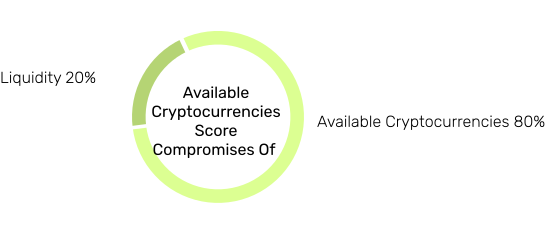
Coinflare provides a modest range of crypto assets but lags behind major exchanges in overall liquidity and listing options.
🪙 Supports 91 trading pairs
💵 USD, EUR, GBP, and CAD are supported for fiat interactions.
🔍 USDT is the only stablecoin offered across the platform.
| Coinflare Crypto Offerings | Availability |
| Available Cryptocurrencies | 10 |
| Spot Trading Pairs | 10 |
| Futures Markets | 91 |
| CoinMarketCap Liquidity Score | 295 |
| Launchpad | No |
Coinflare does not publicly disclose its token listing process. Unlike exchanges like P2B, its site or app does not have visible documentation, contact points, or listing criteria. This lack of transparency can be a hurdle for projects seeking to get listed.
Coinflare offers limited fiat and stablecoin options. During testing, USD, EUR, GBP, and CAD were supported for fiat transactions, and USDT was the sole stablecoin available in both spot and futures markets. Users looking for alternatives like USDC or DAI may find this limiting.
Liquidity is a weakness for Coinflare. According to CoinMarketCap, its liquidity score is 295, significantly lower than platforms like Binance, Bybit, or even Tapbit. While small market orders executed smoothly during testing, larger trades showed signs of slippage, making Coinflare less suitable for high-volume traders.
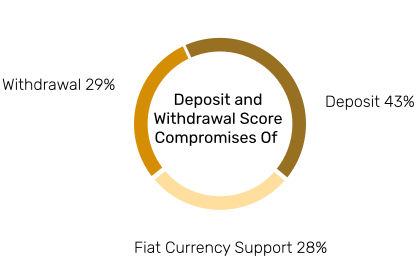
Coinflare has very limited deposit and withdrawal options.
Coinflare offers only basic deposit and withdrawal options, with limited support for fiat.
💳 Crypto deposits and withdrawals are supported.
🏦 Fiat deposits are available via Alchemy Pay, not directly.
💲 Supported currencies include USD, EUR, GBP, and CAD.
❌ No fiat withdrawals are offered.
After testing the exchange, I found that Coinflare deposits can be made via crypto or through a third-party service like Alchemy Pay. The supported currencies for payment are USD, EUR, GBP, and CAD. You can access this feature through the “Buy Crypto” option on the exchange. However, this is below average, as Binance, Coinbase, Luno, and many other exchanges support direct fiat deposits via bank transfer and credit/debit cards.
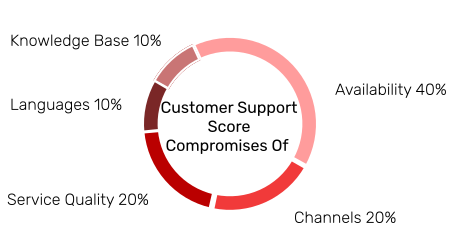
Coinflare offers basic customer support channels but struggles with slow live chat connections and limited real-time assistance.
💬 Support Channels: email & live chatbot.
🌍 Languages: 23, including English, Spanish, Japanese, and Arabic.
⏳ Response Times: Live chat can take 5+ hours, while email replies often arrive in under 18 hours.
| Live Chat Bot | Phone | Languages | |
| 24/7 | N/A | support@coinflare.com | 23 languages (including English, Japanese, Spanish, Arabic, and more) |
To evaluate the quality of customer service for diverse user needs, we created a unique trading test. We personally contact support using all available methods and present hypothetical problems that users might face. Our evaluation concentrates on how quickly they respond, the quality of the help provided, and whether we can talk to a real person rather than a bot. This method effectively measures the capability of customer support to assist both active traders and casual investors.
I started with Coinflare’s live chatbot, expecting quick help. The bot instantly answered simple questions, but things changed once I asked to speak with a real agent. It took more than five hours to connect, and instead of continuing the conversation in chat, I was redirected to email.
From my perspective, this makes the live chat almost useless for real-time issues. While it’s okay for basic FAQs, anything more complicated (like withdrawal fees or trading errors) turns into a long waiting game. Competitors like Tapbit or BYDFi handle live chat much better.
After the chatbot disappointment, I tested email support. Here, Coinflare impressed me. I got a detailed reply in just two hours, which is much faster than the industry norm of 12-18 hours.
Even better, the agent answered every question clearly, including tricky ones about proof of reserves, insurance, and uptime, which many exchanges avoid. The English was clear, the instructions were practical, and overall, it felt professional. Compared to my experience with P2B (where language issues made answers confusing), Coinflare’s email support stood out as one of the best.
Dirk Van Haster is a crypto trader and content analyst with a degree in business and economics. Active in the crypto space since 2020, he focuses on long-term holding and DCA strategies. At FXEmpire, he has written dozens of crypto exchange reviews and creates in-depth content on Web3 topics.
At FXEmpire, we strive to provide unbiased, thorough, and accurate exchange reviews by industry experts to help our users make smarter financial decisions.